

#12: Memory Work & Overground Railroads
Celebrating Black History Month

Memory Work
Happy Black History Month! While I always look forward to celebrating this month, I remain sobered by the fact that we are living through a time of renewed attacks on Black history and memory. Last year, the Trump administration returned artifacts held at the National Museum of Black History and Culture in accordance with a racist executive order and just last month the administration removed an exhibit about enslavement at the President’s House Site in Philadelphia. As jarring as these kinds of removals are, it’s also true that Black history exists beyond the walls of institutions. So much beautiful, profound and needed documentation and preservation of our culture, liberation movements, and lives is being done by small, community-based archives. Georgia Dusk is documenting Black, queer and feminist grassroots movement work in Georgia via oral histories. Black Bottom Archives is centered on archiving Black life in Detroit and stewards the Sankofa Community Research project, which conducts historical research on the effects of the destruction of the Black Bottom and Paradise Valley neighborhood in Detroit. Heaux History is a collective of sex workers who archive and explore Black erotic labor and history. One of their projects, Red Maps, is a geographic representation of where sex workers have long existed in both Chicago and San Francisco.
Please engage with and support these archival efforts. Projects like these help to ensure that our histories will not be erased, and their work underscores the truth that our history is part memory and part instructive. These archives encourage us to study the past, and take lessons from it, so that we may be better prepared to fight for the world we all deserve.
Erin Glasco, Archivist
Events Coordinator, Interrupting Criminalization
Spotlight: Black Memory Workers
Georgia Dusk
“We have to do the work,” says co-founder Dartricia Rollins. “Archivists have a very unique role in our movements and that is supporting us finding the materials, but also in supporting in preserving the materials so that future generations of organizers don’t have to work so hard to learn these things…We have this long history of struggle and solidarity with one another with the goal of ending oppression of all people. And if we can keep that momentum, that history alive, we can get out of the way of ourselves.” Continue reading…
Black Bottom Archives
“We started off as a Tumblr page,” Co-executive Director Marcia Black explains, “and eventually became a digital publication that published stories that Black Detroiters wrote about a variety of topics…Since 2019, we’ve been collecting oral histories from Black Bottom residents and descendants, and we developed a digital archive that we launched in 2020.” Continue reading…
Heaux History
“Clarifying the reality and asserting our existence and historical relevance is the whole basis of Heaux History. As of today, there’s still so little documentation. A main point for us,” founder Rebelle Cunt explains, “is constantly reminding folks that when it comes to social justice movements, particularly post-slavery, there is no social justice movement that exists that doesn’t involve the contributions and the existence of Black sex workers.” Continue reading…
Overground Railroads
The land we live on is abundant in histories of social, cultural, and economic solidarity. The goal of One Million Experiments has always been to illuminate the ways in which that solidarity shows up so that it may help light the way forward. When we look around at the work that abolitionists are doing, we see a series of people and places that, when viewed all together, form a path to safety. We see the stops on an overground railroad to a liberated world.
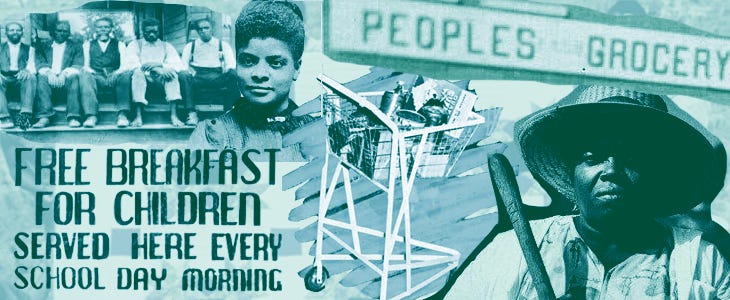
Don’t miss our next zine release, “Overground Railroads” on our @millionexperiments Instagram.
In documenting those stops, One Million Experiments is an accidental archive. The snapshots we take are cursory examinations of complex work rooted in people and places with long lineages — lineages collected as often in museums as in boxes at the back of closets, shared in whispers and zines and Polaroids as much as they are in encyclopedias and exhibits. While we want to continue to document the work happening right now, we are also adding some of the north stars we’ve looked to along the way.
To celebrate Black History Month, we’re sharing a few examples of cooperatives in the United States that highlight the ways in which Black communities have pooled their collective resources and knowledge to keep people, places, cultures, and traditions alive. Our co-ops, unions, collectives, and pods are part of a long and largely unbroken line of people whose survival can be summed up in one word: reciprocity.
As Erin writes, “history is part memory and part instructive.” It is not enough to acknowledge there are shoulders that our work stands on: we must engage deeply with histories of solidarity and resistance to carry the legacies of that work forward. I’ll also add that history can be a balm. It can be a place to find inspiration, hope, and joy. This month, we hope that Black history can be a balm for you all, so many of whom are out there making it right now.
You can also view and add to our ongoing Transformative Justice Timeline project here.
A Brief Timeline Celebrating Early African American Collectivity
For an overview of cooperative economic practices throughout African American history, check out Jessica Gordon Nembhard’s book “Collective Courage.”
1780s – The Rise of the Underground Railroad
The network of safe houses, routes, and guides that transported enslaved people to the free North and Canada began to organize among Abolitionist societies in the late 1700s, but Black people paved the path long before that. In “History of Work Cooperation in America,” John Curls writes that prior to the organized resistance of the Railroad, “Mutual-aid and survival cooperation both among slaves and among servants were almost universal.” Religious and cultural camaraderie formed a basis for social and economic cooperation, which in turn laid the groundwork for many Black people to survive enslavement, gain freedom, and advance economically. (Courage, 33)
1793 - Philadelphia’s Female Benevolent Society of St. Thomas
Taking over for the Free African Society in Philadelphia, the Female Benevolent Society of St. Thomas was one of the first Black women’s mutual aid societies. In these societies, Nembhard writes in Collective Courage, “Black women established day nurseries, orphanages, homes for the aged and infirm, hospitals, cemeteries, night schools, and scholarship funds. They pooled ‘meager resources,’ sponsored fund-raisers, solicited voluntary contributions, and used modest dues that even the ‘poorest women managed to contribute’ to meet vital social welfare needs.” (Courage, 43) 1793 was also the year of one of the worst outbreaks in Philadelphia of Yellow Fever, which ravaged the United States throughout the late 17th and 18th century. While rich white people had the means to flee, poorer Black communities and enslaved people were forced to shelter in place, providing their own disaster relief networks, including aid societies for the poor and vulnerable.
The Black women’s club movement preceded women’s suffrage by more than a century and would ultimately plant the seeds for the Civil Rights Movement decades after that. (For example, the Woman’s Political Council of Montgomery, a local Black women’s club, was the initial organizer of that city’s bus boycott in 1955.)
1836 - The Société d’Economie et d’Assistance Mutuelle
The Economie was a benevolent organization formed by Creole men based in New Orleans, and uniquely defined by its international reach, cultural influence, and longevity. Like many of the benevolent and mutual aid societies that proliferated during this time in New Orleans and elsewehere, the group collected dues from members to provide financial support for things such as healthcare and funeral costs, provided a social network for entrepreneurial efforts, and maintained a library, archives, and meeting place. Starting with fifteen members, initiation originally cost $25. Events held in the Economie hall are cultural legends.
Today, the legacy of the social aid and pleasure clubs that started in the 19th century continue to unify communities as they carry on traditions in cultural organizations and with Mardi Gras krewes and their second lines. The jazz musician Sidney Bechet, who played at the Economie hall along with other New Orleans greats like Louis Armstrong, once said that, “One of those parades would start down the street and all kinds of people when they saw it pass would forget all about what they was doing; you stop working, eating, any damn thing, and you run on out, and if you can’t get in it, you just get as close as you can.” (“Sundays in the Streets”)
1863 - Combahee River Colony
The Combahee River Colony in South Carolina consisted of several hundred African American women living in the Gullah Geechee communities and the Georgia Sea Islands who came together while the men from their communities went off to join the Union Army during the Civil War. Nembhard writes that, “they occupied abandoned farmland where they ‘grew crops and cared for one another.’ They refused to work for Whites and were proud of their handicrafts and cotton crop, as well as their independence.” (Courage, 38)
On June 2, of this same year, Harriet Tubman and 150 African American Union soldiers liberated more than 700 slaves in the Combahee Ferry Raid in nearby Beaufort, South Carolina. Over a century later, the Combahee River Collective would release their 1977 statement, a seminal Black feminist work.
1886 - Colored Farmers’ Alliance and Cooperative Union
The Alliance was established by sixteen black men on a farm in Houston County, Texas. Faced with the threat of mob violence, they first operated as a secret organization and would collapse a decade later after the Leflore Massacre, suppressed by white violence. Denied entry by the Southern Farm Alliance, the organization’s economic efforts were ultimately failures, pushing the Alliance in a radical political direction. They “trained members in economic and political governance, promoted character-building programs, supported mutual aid in their community, argued for more schools for African American children, agitated for more humane treatment of black convict farm laborers, and taught members about their civil rights.” (“The Black Populist Movement Has Been Snuffed Out of the History Books”) The Alliance published a weekly newspaper, engaged in boycotts, strikes, and even helped create the independent People’s Party. In 1890 the organization boasted over a million members with exchanges throughout the New South. Though short-lived, it would prove to be an important link in time between mutual aid societies and the new cooperatives that would continue the collectivization of resources throughout the South. (Courage, 58)
1889 - People’s Grocery
At the end of the 19th century, Memphis, Tennessee was the fifth biggest wholesale grocery market in the United States. On the outskirts of the city in the Curve neighborhood, white grocer William Barrett maintained a monopoly on the grocery business until a small group of Black community members pooled capital to open People’s Grocery. Co-owned by ten Black residents, including pioneering investigative journalist Ida B. Well’s friend Tommie Moss, the cooperative was a beloved destination for Black people near and far, and a resounding financial success. Within three years of opening, primary owners Calvin McDowell, Thomas Moss, and Will Stewart were killed by a white lynch mob and the store was shuttered.
Historian Faron Levesque writes that, “The story of People’s Grocery is a foreboding of future actions of white supremacist terrorism against Black businesses in East St. Louis, Illinois; Elaine, Arkansas; and Charleston, Houston, and Knoxville, as well as the destruction of ‘Black Wall Street’ in the Tulsa Massacre of 1921.” (“Ida B. Wells and People’s Grocery”) “This,” Wells wrote, “is what opened my eyes to what lynching really was.” Wells would build and transform vast networks of political education in her anti-lynching crusade in the 1890s, including publishing the “Red Record,” a book that detailed the history and catalogued the statistical data on lynching. Despite the tragic end to People’s Grocery and many other unnamed stores, cooperatives and buying clubs of all kinds would continue to play a key role in economic survival and advancement of Black communities throughout the South and beyond.
What local, national, and international groups have been important north stars for you?
For more examples of collectivity throughout history, browse the One Million Experiments database, and send us your picks. Submit a project here or email eva [at] interruptingcriminalization.org.
Eva, One Million Experiments Fellow
Thank you for reading the One Million Experiments Newsletter. If you like what you see, please consider sharing it with a friend.
Explore our catalog of projects, podcasts, and zines at millionexperiments.com and follow us on Instagram @millionexperiments.